
History in popular memory is often a game of broken telephone. Stories get garbled and myths get repeated until they simply become what everyone knows happened. But when you go back to the original documents, you often find yourself quite surprised. The history of transit in Toronto is no different. Below, I’ve collected eight myths that people have come to believe. Some of them are partially true, while some are straight up factually false, but I think that setting the record straight will help us better understand the system we ride and how it came to be.
Myth 1: The Yonge Subway was paid for out of the fare box
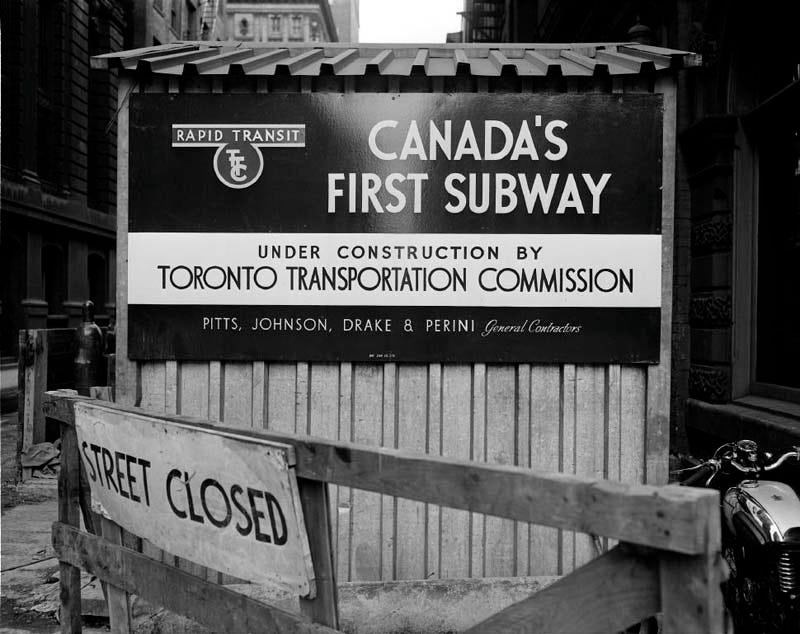
Torontonians voted on New Year’s Day 1946 to begin construction of Canada’s first subway system. The TTC had emerged from the war with a $25 million surplus and the expectation was that they could cover the new subway’s cost with the surplus and federal postwar reconstruction money. Alas, the federal money never materialized and a planned Queen Street tunnel was dropped. The Yonge line ended up costing $58.5 million, which much of it borrowed against future farebox revenues. As it turned out, ridership continued to decline and the farebox didn’t come close to covering the debt. On Dec 6, 1963, Metro Council voted to assume $51.8 million in TTC subway debt and to raise Metro’s share of future subway construction from 55% to 70%. It was Metro’s taxpayers that ended up covering a big chunk of the Yonge subway’s cost, not TTC farepayers.
Myth 2: The TTC was profitable before they got rid of the zone fare
In 1973, the TTC finally got rid of the double fare that residents outside the old City of Toronto had to pay when travelling downtown. We’ve often heard that decision blamed for the end of the TTC’s ability to support itself financially, but that’s not true. The TTC was already running an annual deficit in the mid-1950s and Metro began covering deficits with ad hoc subsidies. This was a perpetual political sore point as suburbanites pointed out that their taxes were bailing out the TTC while they were getting hit with much higher fares than downtowners. In August 1962, Metro Council voted 13–10, after eight hours of debate, to request formal provincial permission to subsidize transit. The TTC had lost 15 million riders in 1961 alone and the councillors embraced the concept of subsidy in order to fund the expansion of suburban transit service, as well as to minimize a planned fare hike.
The myth might come from the timing of the double fare’s elimination, but it gets the causality backwards. A few weeks after Bill Davis announced the cancellation of the Spadina Expressway in 1971, he announced a generous provincial subsidy program for transit. Queen’s Park would thenceforth cover as much as 50% of agency deficits. New TTC board member and North Yorker Paul Godfrey saw this as the opportunity to as last get rid of the double fare. Eliminating the double fare had not led to the subsidy. On the contrary, the subsidy had allowed for the elimination of the double fare. As it turned out, eliminating the zone fare ended up costing far less than expected because ridership jumped 12.3% as a result.
Myth 3: The streetcars were doing great until recently
In the 1950s, the TTC’s streetcars moved incredible numbers of people. The Bloor streetcar alone moved almost as many people as a subway line, with streetcars coupled together to carry the heavy loads. The TTC’s slogan was “always a car in sight,” since they were so frequent you could always see the next one coming. Back then, several routes carried in excess of 100,000 people every day. As of 2024, even the busiest King car moves only 61,000 a day and the Queen car moves 42,000. Dundas and Carlton are even lower. And anyone who has been around a while knows that those corridors have seen massive development and remain home to businesses that draw people from all over the city. There are many reasons for the decline, including reduced service frequency, route management challenges, ever-longer travel times, and vehicle congestion. While subway and suburban bus ridership boomed for decades, streetcar service and ridership declined. Even amid strong overall TTC growth in the 80s, vehicle-miles of service sank from 9.3 million in 1981 down to 8.2 million in 1990. Ultimately, when service gets slower and less frequent, fewer people will ride.
I’m currently working on a project called FastTrackTO that is pushing for various interventions and changes that would improve the streetcar network and likely increase ridership - alongside Reece Martin of The Transit Brief.
Subscribe for free, for infrastories from around the world.
Myth 4: Toronto’s transit has always been stronger than American cities’
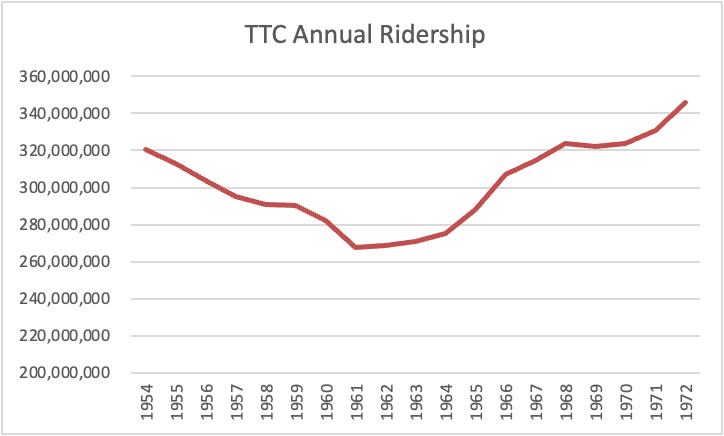
As people were buying cars and suburban houses after the end of the Second World War, Toronto transit ridership declined much like in American cities. That is, until they suddenly turned it around. From 1952 to 1962, Toronto’s transit ridership fell 37.6%, which was quite comparable to Chicago (38.8%), Washington (40.3%), and Philadelphia (41.0%). The opening of the subway in 1954 did little to arrest the decline and the TTC hit its post-Depression nadir in 1961, when its financial survival was an open question. But after the major bus expansion to the suburbs in 1963, the TTC dramatically turned around its fortunes and boomed right up until the late 80s, while American systems typically continued their steady decline for at least another decade.
Myth 5: Expanding transit to the suburbs was a financial disaster
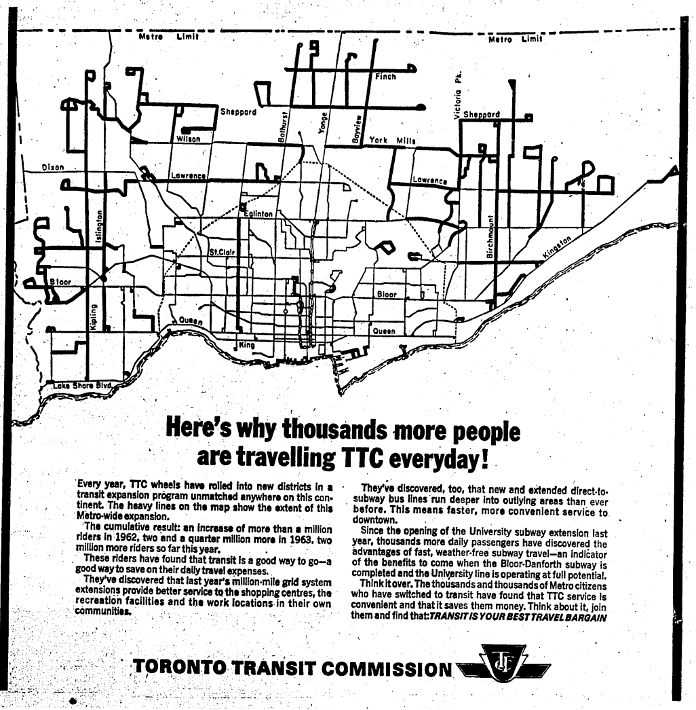
The TTC has operated far more transit service in its vast postwar suburban service area for more than half a century. And over much of that time, it had the lowest subsidy of any major transit system in North America. The TTC’s 1962 Annual Report warned that “bus routes into new suburban districts are heavy money losers, sometimes for many years.” But when they finally got pushed by suburban Metro councillors to radically expand suburban bus service, to everyone’s astonishment the routes turned a $3.9 million profit in the first year and drove suddenly and unexpectedly skyrocketing ridership. The TTC’s consultants had projected 8.25% citywide ridership growth from 1962 to 72, but the actual figure was 28.7%, pretty much all of which occurred in the suburbs. The expansion saved, rather than destroyed the TTC’s independence for many more years. Far from a drain, suburban service is what put the TTC on a much more stable footing.
Myth 6: Nobody rides the Sheppard Subway
We’ve often heard the Sheppard Subway described as a deserted subway to nowhere, but by normal subway standards it’s respectably busy. Toronto has the busiest subway per kilometre in North America, which means we expect trains to be packed for much of the day. That sets up rather unreasonably high standards. Sheppard in 2023-24, despite pandemic related declines, was moving about 39,000 people every day. Before the pandemic in 2019, it was about 48,000. That’s not bad for a suburban stub that’s only six kilometres long. Miami’s Metrorail moves about 50,000, and it’s nearly 40 kilometres long. It’s busier than many US light rail systems that are dozens of kilometres long. Toronto’s subway is successful because most of its ridership comes from connecting buses, so the catchment area of stations is far larger than just the distance people could walk. Considering that the Sheppard subway was truncated to Don Mills, so it only connects with one notably busy north-south bus route, its ridership is pretty high. If it continued east to connect with the busy Victoria Park, Warden, and Kennedy buses, or west to connect with the other leg of Line 1 it could be expected to be much busier.
Myth 7: Transit City was killed
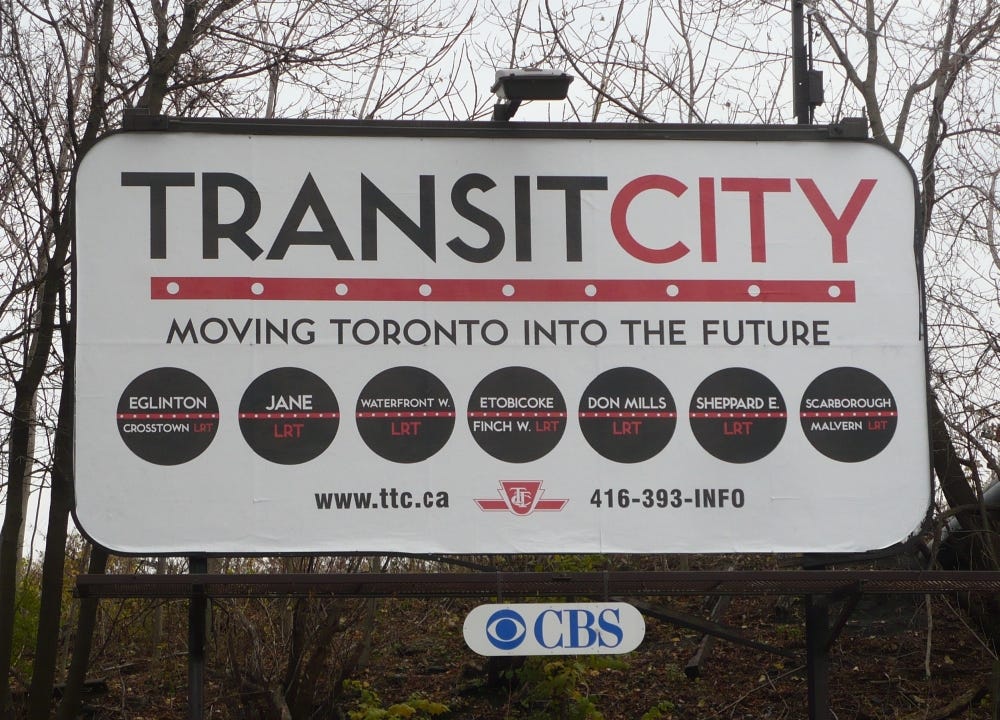
We’ve often heard that Transit City was killed, but it’s been the basis for much of Toronto’s planning since it was unveiled in 2007, and we’ve built many of the most significant sections. The original Transit City plan included:
Eglinton Crosstown LRT
By far the largest project of the whole Transit City plan, the line was built as planned and is now open.
Its west extension to Renforth is now under construction, although it will be underground while the Transit City plan likely intended for that section to be above ground. If anything this is an upgrade.
Finch West LRT
Built as planned and now in service
Don Mills LRT
The Don Mills LRT from Pape Station to Don Mills and Sheppard faced the same constrained road alignment on its southern section. More than half of the line is now under construction as the Ontario Line, which will cover the Pape Station to Don Mills and Eglinton section and is another upgrade.
Long term planning suggests potential northern extensions of the Ontario Line that would effectively complete the Don Mills line.
Sheppard East LRT
This project was planned to run from Don Mills station on Line 4 to somewhere around Twin Rivers and Sheppard.
It is now being studied, likely as a subway to a junction point with Line 2 near Scarborough Town Centre.
Scarborough-Malvern LRT
This line was planned to run from Kennedy Station east on Eglinton, Kingston Road, and Morningside to UTSC and Sheppard.
This line is currently under study and considered a priority of the City of Toronto.
Waterfront West LRT.
This was a short line from Exhibition Loop to connect to the Queensway streetcar ROW, so that the streetcars from Long Branch could run onto the 509 corridor.
This project is still planned by the city as part of work in the area around Exhibition place with a new section of track connecting to King Street along Dufferin.
Jane LRT
This line was to run from Bloor to Steeles West station.
It was likely unbuildable as the fully surface LRT that Transit City had called for, since the southern section of Jane Street is too narrow to fit a full ROW.
Notably, the original Transit City did not include rebuilding the former Scarborough RT to run low-floor LRVs, which was a concept that later became associated with the plan.
Out of all the seven Transit City lines, two have been built as planned, including the largest single project. One is being mostly built as part of the Ontario Line subway. Two are currently high priorities in the planning process, with another likely to happen as Liberty Village and the Ex continue to develop. The last one was likely unbuildable as planned. That’s a pretty successful record of follow-through for any transit plan.
Myth 8: The Danforth urgently needs intensification to support subway ridership
The point here is not that intensification is not valuable. It’s that Line 2 along the Danforth is already an extremely busy line. At peak periods, riders at many of the stations along the Danforth struggle to squeeze onto trains that are already packed with riders coming from further east in Scarborough. (Capacity should increase as new trains and CBTC signalling are introduced into the 2030s.) The Danforth’s stations are also already pretty busy, especially when they are fed with the connecting buses that bring most subway riders to stations. But even Chester station, with no bus service at all, is busier than every BART station except a handful in downtown San Francisco. This is because a bustling commercial area and a good transit mode share can create high transit ridership even without very high residential density. And sometimes height isn’t everything. Even a large condo with 300 units might generate a couple hundred trips a day, which could be far less than a much smaller medical office building, for example, that might have dozens of medical practitioners, each of whom might see an average of a dozen patients per day coming from all around. Dense commercial development usually generates the most ridership of all.
If there is a corridor, however, that cries out for intensification, it’s the western leg of Line 1. Of all the four radial routes into central Toronto, the Spadina line is the only one that has always had ample excess capacity. There’s no better place in the city, from a transportation perspective, to put high-density development.
The other thing conventional wisdom gets wrong is that we have high fare recovery of operating costs (often 70% is mentioned)...but that hasn't been true since before covid, and it's around 40% now with the fare freezes under Tory and Chow and increased service (but lower ridership).
More money is coming from property taxes. Which is a transfer of costs onto the local population since about 13% of fares came from outside of the city (tourists, commuters, etc)
No one thinks that literally nobody rides the Sheppard Subway. The point is that it is a comparative wasteland. Saying that its ridership is "not bad for a suburban stub that's only six kilometres long" is begging the question. That's the whole point, it was a bad idea to spend so much money on a suburban stub!