
We all know that Europe and Asia are the home of modern passenger rail, while North America lags far behind. Canada’s mainline railways move about 36 passenger-kilometres per capita[1] each year, while the European Union’s move 984. What many people might not know is that North America dominates in freight rail, while Europe largely lags far behind. The EU moves 833 annual rail freight tonne-kilometres per capita each year, while Canada moves 10,660. Canada alone moves more tonne-kilometres of freight by rail than the entire European Union combined. And that’s not just heavy natural resources in the West. It’s also vast amounts of intermodal and industrial goods. North American freight railways get thousands of trucks off the roads and that is something we should be genuinely proud of. I get concerned when I sometimes see passenger rail advocates treat freight railways as unreasonable obstacles. They’re simply trying to keep what has made them so successful. The problem is that the needs of modern freight and passenger rail are fundamentally different, and trying to run both on a single shared network will inevitably end with one far weaker.
North American freight railways do a brilliant job of the main thing that matters for freight, which is low cost per tonne. Freight shippers generally don’t care if it takes a little longer, whether it arrives a few hours earlier or later in the day, or how comfortable the ride is. They want it to get there cheaply. The way to do that is to pack as much cargo into each train as possible. North American freight trains make European freight trains look like toys. A typical European freight train is about 1,500 tonnes and 750 metres long. North American freight trains can be well over 20,000 tonnes and four kilometres. On an intermodal train, it works out to nearly ten times as many containers per train as in Europe. Technology allows the crew in front to control locomotives distributed throughout the train so that the couplers at the front aren’t pulling the train’s full weight. North American freight railways have undertaken massive reconstruction of their network over the past decades to increase clearances so that trains on most main lines can handle two containers stacked on top of one another. All of this means two people in a locomotive cab can move an incredible amount of cargo. Since labour is often the largest cost or close to it, that’s an immense efficiency difference.
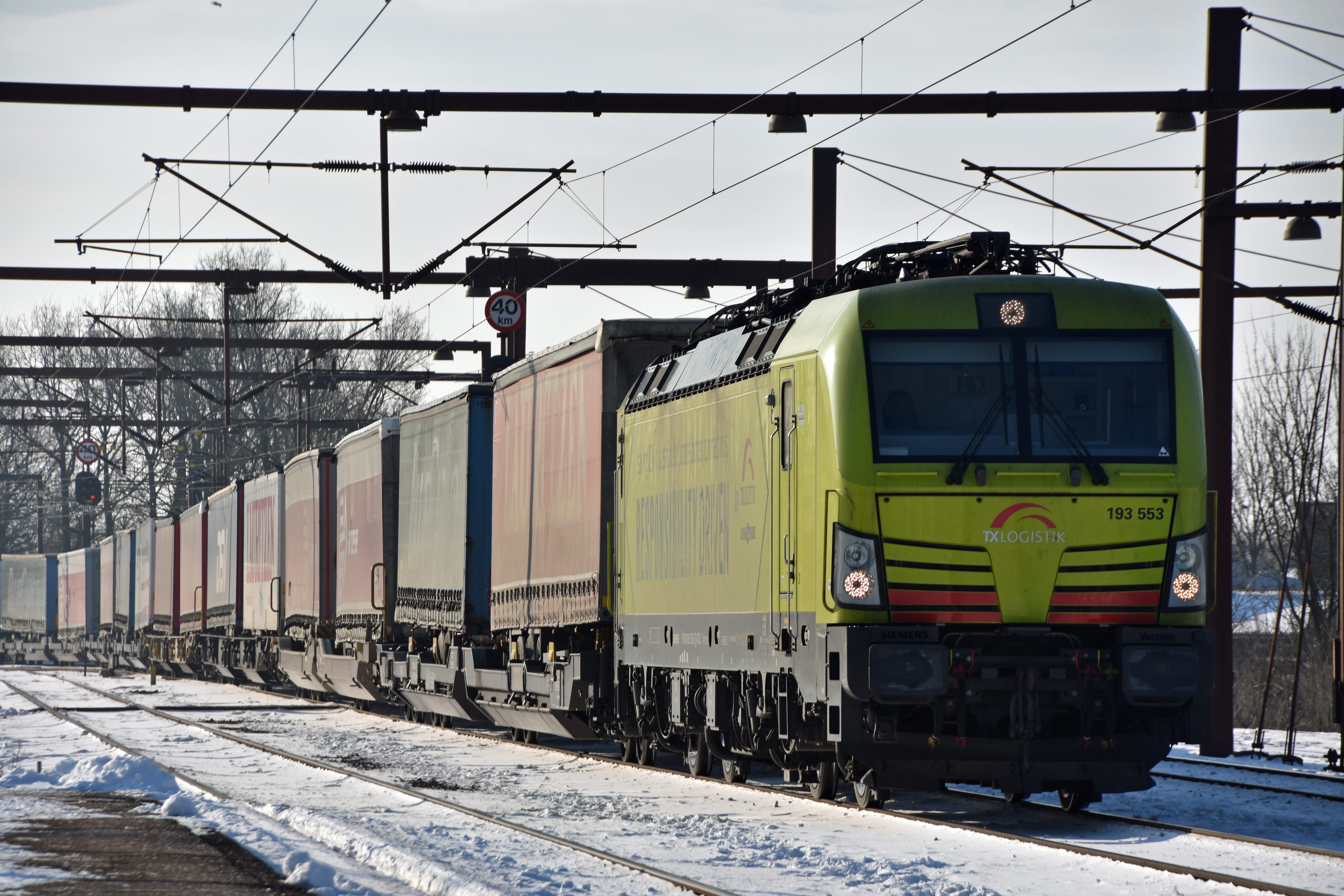
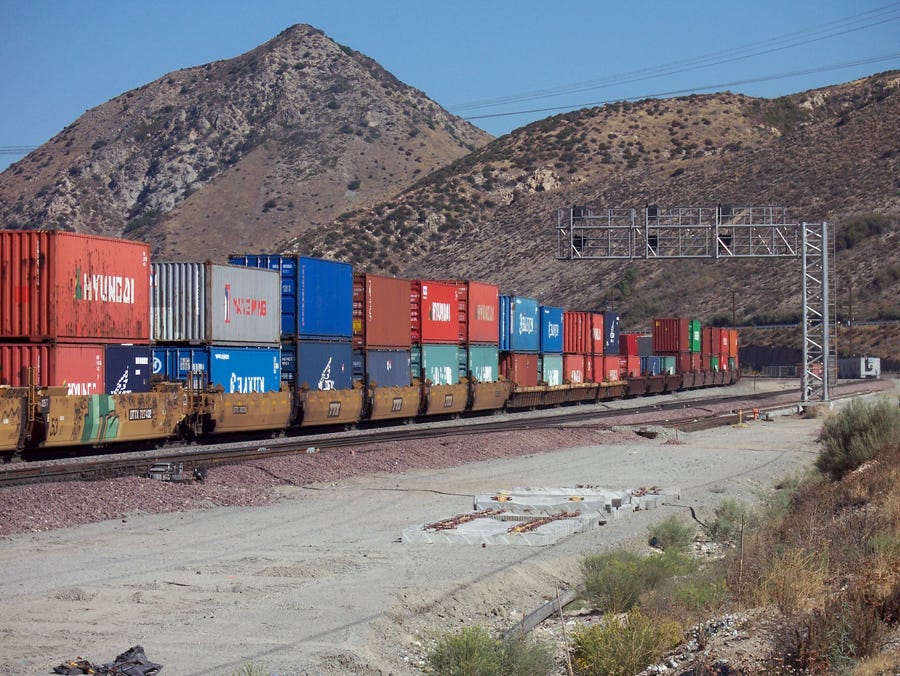
Trains usually leave once a day between any two points and, in many cases, far less frequently. Though there’s much talk about precision scheduled railroading in North American freight, that — ironically — doesn’t mean a precise schedule to the minute like a passenger would expect. Freight tracks don’t need high speeds, and their signalling systems don’t need to run trains very often. Tunnels are often built without complex ventilation, because it’s fine to just wait an hour or two for the diesel exhaust to clear before the next train passes.
The North American freight network is also genuinely integrated across the continent. Every day, trains run right through from Mexico to Canada without needing to swap locomotives or follow significantly different rules. That’s very different from Europe, where cross-border freight has to contend with different signalling, different electrification, and often different regulations altogether. It doesn’t mean there’s no cross-border freight traffic, but it’s significantly more complex and that makes it less competitive. Oil bound for southern Germany from the Middle East takes the most direct route through the Suez Canal to Trieste and then travels the rest of the way by pipeline. But most Germany-bound container traffic goes all the way across the Mediterranean, around Iberia, through the English Channel, and up to the North Sea ports at Antwerp, Hamburg, and Rotterdam, where it can finally be transferred to rail or barge. Freight trains from Italy to Germany would have to cross the Alps, which is a legitimate but hardly insurmountable barrier. Huge amounts of freight cross the Rockies every day.
Subscribe for free, for infrastories from around the world.
Even the massive new tunnels being planned and built under the Alps to ostensibly solve the problem are not always working as part of an integrated freight network. Switzerland’s immense Loetschberg Base Tunnel, for example, for years carried huge numbers of trucks that get on trains at the Italian border, ride trains under the mountains, and then get back on the road once they reach Germany. Though it’s gradually getting better with more or the traffic on traditional intermodal trains, that’s a tell-tale sign of a poorly integrated freight network.
Rather than length and weight, successful passenger service needs frequency, speed, and reliability. Greater weight per axle improves freight efficiency but also significantly increases wear on tracks, which hurts speed and comfort. Inconsistent freight schedules don’t mix well with passenger trains running every few minutes. And high freight-train weights have long prompted regulators to impose safety standards that also require passenger equipment in North America to be far heavier and therefore less efficient than in Europe and Asia, though this is finally starting to change. We design passenger trains like a 1950s Chevy, where sheer mass is the main safety feature, while European rolling stock uses far more advanced technology like the crumple zones that are used on a much lighter modern Toyota.
North American signalling, designed around freight needs, can afford to keep trains widely spaced because almost no freight line runs more than a few trains per hour. In Europe, or on a North American subway that’s not part of the national rail network, a double-track line can routinely carry 24 trains every hour in each direction. In North America, the same two rails 1,435 mm apart would be considered aggressively used if they handled four per hour, aside from a handful of exceptions like the Hudson River tunnels where freight traffic is excluded.
Freight standards can also massively increase cost in an urban environment relative to what might be possible using European passenger rail standards. In general, a conventional North American railway is built for 1% grades, while modern electric passenger trains can easily handle 3%. That means that raising a track seven metres to clear a road or another rail line needs about 1,400 metres of construction, rather than potentially only about 467 metres. That’s a lot of extra money and disruption, and in a city it often means closing off street crossings entirely.
High locomotive weights compound the problem. In North America, even lightweight passenger cars are generally pulled by a locomotive that is as heavy on each axle as one designed for hauling freight over the Rockies. They typically are about 30,000 kg per axle, while a comparable European locomotive is about 20,000 kg. This means bridges and other structures have to be built far heavier than they’d otherwise need to be.
The solution here isn’t kicking freight off major parts of the rail network or somehow trying to make it copy the far less successful models in Europe. But we also can’t keep running our passenger railways, especially in dense urban and intercity corridors, like they’re freight trains with chairs.
Meanwhile, in Europe, even some new high-speed railways are built to accommodate freight, requiring freight trains to move at far higher speeds than is most efficient while also forcing the engineering of the line to be more expensive than it would be otherwise. They are making basically no serious efforts to permit double-stacked containers or longer trains. Even a dedicated new freight-only railway has far lower weight limits than North America and won’t allow double stacks. In most cases, freight cars are still manually coupled using a chain, rather than the semi-automated Janney couplers that North American railways have been using for the past century-and-a-half. In other words, they’re trying to run passenger trains with cargo instead of people.
In case you wondered, double stack container trains can operate under overhead railway electrification systems. This can be seen in the northeastern US, and on India’s new dedicated freight corridors.
The problem may fundamentally be that we force two fundamentally incompatible users together on the same network and wonder why one always comes out the loser. In a future post, I’ll write about what a better way might look like.
[1] Statistics Canada. Table 23-10-0057-01 Railway industry summary statistics on freight and passenger transportation
Passenger-kilometres per capita equals total passenger-kilometres divided by population. One passenger-kilometre represents one passenger transported one kilometre
Fantastic stuff Mr English. Would love some policy recommendations at the end though.
Finally, someone who can talk about the tradeoffs!!!